Minggu, 22 Mei 2011

The Seven WondThe Seven Wonders of the Ancient World

The list of Seven Wonders of the Ancient World belongs to a category of texts and Greek myths written by the Ancient Greek historians and travelers.

Myth and reality about the Seven Wonders of the Ancient World

Although not completely mythological, the Seven Wonders of the Ancient World were associated with several Greek myths and heroes of the Greek Mythology and became the ground for numerous more legends in the years to come.
The Seven Wonders of the Ancient World were splendid buildings worthy of prevalence.  According to the historians, the original list of the 7 wonders, including only Greek buildings was lost. The list of the wonders as we know it today was created approximately in the 3rd century BC, expressing the novel idea that both Greek and “barbarians” – meaning not Greeks – were able to produce fine pieces and works of art.

How was the list of the Seven Wonders of the Ancient World created?

After the conquests of Alexander the Great, many travelers from the Greek mainland got access to the ancient civilizations of the Persians, the Babylonians and the  Egyptians. These travelers were smitten by the beauty and the marvels of the lands they visited and decided to list what they were seeing, in order to remember the worthiest easier. In Greek, the word used for these marvels of the ancient world was “theamata” which means “the must- sees”.
The most known list, on which our knowledge for the seven wonders of the World is based, is the list of Antipater of Sidon and an observer identified as Philon of Byzantium. However, we are still not sure that some of these wonders were real, and not part of a Greek Myth or foreign legend.

What are the Seven Wonders of the Ancient World?

The seven wonders of the Ancient World are:
  1. The hanging gardens of Babylon
  2. Phidias' statue of Zeus in Olympia
  3. the Lighthouse of Alexandria
  4. The colossus of Rhodes
  5. The pyramids of Egypt
  6. The Mausoleum of Halicarnassus
  7. The temple of Artemis in Ephesus
The Hanging Gardens of Babylon
the Hanging Gardens of Babylon
Diodorus Siculus described the hanging gardens of Babylon as  multi-leveled gardens reaching 22 m high, with an amazing machinery for circulating water. The gardens were built on the bank of the Euphrates River by Nebuchadnezzar II for his wife Amytis of Media. The gardens were destroyed in the 1st century BC by a massive earthquake. It is not completely certain that these gardens existed, or was a product of the vivid imagination of the ancient Greeks who liked creating myths, but it seems that there are sparkles of reality there.
Phidias' Statue of Zeus in Olympia
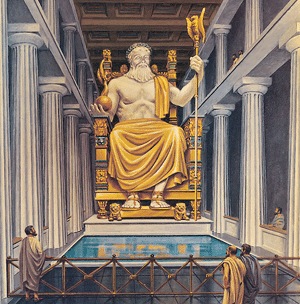
The statue of Zeus in Olympia
The statue of Zeus was built in 466 BC. It occupied the entire width of the aisle of the temple in Olympia that was built to house it, and was 12m (40 feet) tall. The statue was made of gold and ivory.. In the fourth century AD, the Roman emperor Constantine the Great ordered it to be dismantled, and had it transported to Constantinople, the new capital of the Roman empire. The statue was destroyed in a fire.
The Lighthouse of Alexandria
lighthouse of alexandria
The lighthouse of Alexandria in Egypt was built during the 2nd century BC and was between 115 and 135 meters tall on a small island at the entrance of the port of Alexandria which was called Pharos. Pharos in Greek means Lighthouse. The lighthouse of Alexandria was among the tallest buildings in the world for many centuries.
The Colossus of Rhodes
colossus of rhodes
The colossus of Rhodes was a gigantic statue of Helios, the Greek Sun God, It was 35 m (110 ft) tall. The statue was erected at the entrance of the port of Rhodes. According to the legend, the statue stood with one foot on either side of the harbor, although this is not confirmed. The statue was destroyed in 226 BC at the Rhodes Earthquake, only 56 years after its construction.
The Pyramids of Cheops in Egypt
the pyramid of cheops in Egypt
The pyramid of Cheops in Egypt was built around 2,500BC and was the oldest of the seven wonders. It is also the only one standing till today. It is almost unknown how these constructions were built, giving birth to several myths and legends. The pyramid of Cheops is also known as the Great Pyramid, and was the tomb of King Cheops.
The Mausoleum of Halicarnassus
the mausoleum of halicarnassus
The Mausoleum of Halicarnassus stood approximately 45m (135 feet) tall with each one of the four sides adorned with sculptural reliefs. It was built in 351 BC as a tomb for Mausolus, a Persian Satrap. It is said that the wealth of the Mausoleum was unbelievably huge. It was destroyed  in AD 1494, since it was disassembled by the Crusaders who entered  Halicarnassus.
The temple of Artemis in Ephesus
the temple of artemis in ephesus
The temple of Artemis was built in the Greek City of Ephesus – in Turkey today. It was dedicated to the Goddess Artemis (Diana) and took 120 years to build. Herostratus, a young man in Ephesus, decided to burn it down, to achieve long lasting fame. Alexander the Great rebuilt it, but it was again destroyed by the Goths. Once more it was rebuilt in early 2nd century AD, but it was destroyed once and for all by St John Chrysostom in 401AD, because it was a pagan temple.

The Seven Wonders of the Modern World

The name Seven Wonders of the World remained until recently, honoring the list made by the ancient Greeks. However, since recently there was a new list of the Seven Wonders of the Modern World, the original list was renamed to Seven Wonders of the Ancient World.

Reference : http://www.greekmyths-greekmythology.com/the-seven-wonders-of-the-ancient-world/

Rabu, 18 Mei 2011

5 Fakta Jepang Setelah Terkena Bencana

jepang,mungkin kata negara itu sudah mendunia sejak akhir minggu kemarin,
ya,bencana gempa bumi yang terjadi jum'at 12 maret 2011 tepatnya pada pukul 14.20 sampai beberapa menit setelahnya jepang telah dilanda gempa berkekuatan 8.9 SCR bahkan mungkin badan arkeologi dan geofisika menetapkan bahwa gempa tersebut berkekuatan 9.0 SCR,setelah kejadian gempa berkekuatan 8.9 SCR bahkan mungkin hampir mendekati 9.0 SCR berlangsung hampir selama 10 menit,yang telah meratakan tanah air jepang.

  belum pulih dari sakitnya yang maha kuasa telah memberi cobaan kembali pada jepang.
sesaat setelah gempa tersebut,gempa di hembas ombak besar hampir setinngi 10 m.dan telah meneggelamkan 4.000 rumah bahkan lebih,lebih dari 2000 orang di temukan tewas dan hilang bahkan setelah di cari lebih dan lebih,tinggkat kematian naik drastis dan menunjukan angka 5000.dan,satelah gempa terjadi beserta tsunami mengalami perubahan secara ajaib!

  ini adalah 5 fakta yang mungkin belum terjadi pada negara-negara sekitarnya,

*anak-anak kecil di jepang dari mul;ai usia 4-6 tahun sudah diajarkan cara mengobati atau
menangani luka-luka,sehingga masing-masing anak membawa rancel berisi perban dan obat-obatan serta uang
dan keperluan lainnya

*setelah terjadi gempa bumi dan tsunami jepang bangkit dan menjalani kebiasaan sehari-hari
jepang mulai memulai aktifitas seolah-olanh tidak terjadi apa-apa sebelumnya,jepang tidak memikirkan masalah apa yang terjadi kemudian hari

*setelah tsunami usai,dan seorang kakek tua berumur 60 tahun terombang ambing di tengah laut hingga membawanya sejauh 5 km dari rumahnya dan mencoba bertahan lebih dari 5 hari bahkan 8 hari terombang-ambing di tegah lautan.

*seorang nenek bernama saozuke dan anaknya terjebak di atas reruntuhan bangunan
dan bertahan tanpa makan dan minum,setelah di gali,nenek dan anaknya terbukti selamat dan ada sedikit luka yang benar-benar parah

Sumber : http://5fakta-jepang.blogspot.com/

Momotaro

Momotarō (桃太郎?) adalah cerita rakyat Jepang yang mengisahkan anak laki-laki super kuat bernama Momotarō yang pergi membasmi raksasa. Diberi nama Momotarō karena ia dilahirkan dari dalam buah persik (momo), sedangkan "Tarō" adalah nama yang umum bagi laki-laki di Jepang.
Dari nenek, Momotarō mendapat bekal kue kibidango. Di perjalanan, anjing, monyet, dan Burung Pegar ikut bergabung sebagai pengikut Momotarō karena diberi kue.

Ringkasan cerita

Di zaman dulu kala, hiduplah seorang kakek dan nenek yang tidak punya anak. Ketika nenek sedang mencuci di sungai, sebutir buah persik yang besar sekali datang dihanyutkan air dari hulu sungai. Buah persik itu dibawanya pulang ke rumah untuk dimakan bersama kakek. Dipotongnya buah persik itu, tapi dari dalamnya keluar seorang anak laki-laki. Anak itu diberi nama Momotarō, dan dibesarkan kakek dan nenek seperti anak sendiri. Momotarō tumbuh sebagai anak yang kuat dan mengutarakan niatnya untuk membasmi raksasa. Pada waktu itu memang di desa sering muncul para raksasa yang menyusahkan orang-orang desa. Momotarō berangkat membasmi raksasa dengan membawa bekal kue Kibidango. Di tengah perjalanan menuju pulau raksasa, Momotarō secara berturut-turut bertemu dengan anjing, monyet, dan burung pegar. Setelah menerima kue dari Momotarō, anjing, monyet, dan burung pegar mau menjadi pengikutnya. Di pulau raksasa, Momotarō bertarung melawan raksasa dengan dibantu anjing, monyet, dan burung pegar. Momotarō menang dan pulang membawa harta milik raksasa.

Sumber :  http://id.wikipedia.org/wiki/Momotaro

Fakta Unik Tentang Bahasa Inggris

1. Stewardesses adalah kata terpanjang yang dapat diketik di keyboard hanya dengan menggunakan tangan kiri Anda. Sedangkan untuk tangan kanan, lollipop adalah yang terpanjang.

2. Tidak ada kata dalam bahasa Inggris yang bersajak/berima dengan month, orange, silver, purple, angst dan scalp.

3. Dreamt adalah satu-satunya kata bahasa Inggris yang berakhir dengan huruf ‘mt’.

4. Kalimat The quick brown fox jumps over the lazy dog menggunakan setiap huruf yang ada dalam abjad.

5. Kata racecar, kayak dan level dapat dibaca bolak-balik dari kiri ke kanan ataupun dari kanan ke kiri.

6. Hanya ada empat kata dalam bahasa Inggris yang berakhir dengan suku kata ‘dous’, yaitu: tremendous, horrendous, stupendous dan hazardous.

7. Ada dua kata dalam bahasa Inggris yang menggunakan kelima huruf hidup secara berurutan (a, e, i, o, u), yaitu: abstemious dan facetious.

8. Typewriter adalah kata terpanjang yang dapat diketik menggunakan huruf-huruf yang terdapat pada satu baris tombol keyboard (baris QWERTY).

9. Huruf yang paling sering dipakai dalam bahasa Inggris adalah huruf ‘e’. Ini merupakan fakta baik dalam penggunaan bahasa Inggris secara umum, dalam karya fiksi dan non-fiksi, jurnalisme, kitab suci dan bahkan kode Morse!

10. Untuk huruf konsonan, huruf yang paling sering dipakai adalah huruf ‘t’.

11. Huruf yang paling sedikit digunakan dalam bahasa Inggris adalah ‘q’ – bukan ‘z’.

12. Lima huruf yang paling sering muncul sebagai huruf pertama dalam kata bahasa Inggris – secara berurutan – adalah ‘t’, ‘o’, ‘a’, ‘w’ dan ‘b’.

13. Hampir setengah dari seluruh kata bahasa Inggris diakhiri oleh huruf ‘e’, ‘t’, ‘d’ dan ‘s’.

14. The adalah kata yang paling sering digunakan dalam bahasa Inggris. Bila Anda tidak percaya, cobalah berbicara dalam bahasa Inggris standar yang benar selama 5 menit tanpa menggunakan kata ‘the’.

sumber : http://asalkamutahuaja.blogspot.com/

Sabtu, 14 Mei 2011

London’s Camelot


Alfred, Lord Tennyson has much to answer for.
He may have been a respected poet, a reluctant but noble lord, the first English writer to be awarded an hereditary title for his work. He may have been the author of many poems of great beauty and deep thought, and an early supporter of women’s rights. He may have grown from humble beginnings, as one of eleven children of a clergyman, to become Britain’s greatest poet of the second half of the 19th century.
His appointment in 1850, by Her Majesty Queen Victoria, Queen of Great Britain and Ireland and Empress of India, as Poet Laureate, a position he held until his death 42 years later, was certainly widely popular and regarded by many as richly deserved.
Yet, this is the man whose writings almost single handedly launched the modern myth movement that surrounds the legendary 5th/6th century King Arthur, his court at Camelot, Guinevere, Merlin the Magician, Sir Lancelot and the other Knights of the Round Table, and the quest for the Holy Grail - to mention just a few aspects - that are at the heart of today’s worldwide Arthurian industry. The study of the Arthurian legends brings together scholars, academics, romantics, realists, writers, educationalists, new agers, publishers, researchers and many others, in a whirlpool of theories, symbols, disputed facts, speculation, conjecture, individual interpretation and on-going investigation.
Amongst the very latest manifestations of this quest for Arthurian truth are the recollections of more than a hundred people who under regressive hypnotherapy revealed previous lives in Camelot, 1500 years after the actual period. The ‘Big Bang’ that gave rise to the widespread modern interest and examination of the legends, was Tennyson’s epic story about King Arthur and Camelot, the beautifully written Idylls of the King.
The first of these 12 Arthurian poems was published in 1859. Tennyson’s poetic development of the legends that sprang from the Celtic origins of Camelot - believed by some to have been located at Caerleon-on-Usk, in what is now South Wales, or as proposed by Sir Thomas Malory, in his 15th century literary work"Le Morte d’Arthur", in Winchester, Hampshire - was not well received by some mid-19th century critics.
But the Idylls proved enormously popular with the public and have been the source of great interest and study ever since.
The lack of factual and physical evidence to prove anything beyond argument has long resulted in a plethora of theories about Camelot and its legendary protagonists. Less facts inevitably spells more conjecture and supposition. It’s not surprising then that many mythical connections with the Arthurian legends are encountered throughout southern Britain.
These range from the 12th century identification of Glastonbury, near Wells, in Somerset, as Avalon, the burial place of King Arthur, through to a claimed location for London’s Camelot on the northern edge of rural Trent Park, by Enfield Chase - a thousand years ago the hunting territory of the Kings of England - and close to the present North London border of the Enfield and Barnet boroughs.
The location, which has been described as "an ancient and mysterious archeological site", is known today as Camelot Castle and Camlet Moat. These names go back many centuries although the dates of usage of the names are unclear. What is clear is that there are now few remaining signs of the building reported three centuries ago, but there remains a disturbingly quiet and neglected island site surrounded by a stagnant moat. Many local legends are associated with the location and reports show that in relatively recent times Camelot and Camlet have received much attention from Arthurian seekers-after-the-truth, New Age believers, pagan worshippers and searchers for the Holy Grail.
It is interesting to note that one of the locally recorded 17th century references to the location traces its ownership back to the family of medieval knight Sir Geoffrey de Mandeville, Earl of Essex, stories of whom abound in the area and whose ghost has been seen to appear in the neighbourhood on several occasions over past centuries.
This connection with "The Robber Baron" is supported by a description in the novel "The Fortunes of Nigel", by one of Britain’s foremost 19th century writers and poets, Sir Walter Scott. He uses Camlet Moat as a setting in the novel, which was published in 1822; the island being described as marking "the ruins of the abode of a once illustrious, but long-forgotten family - the Mandevilles, Earls of Essex, to whom Enfield Chase and the extensive domains adjacent had belonged in elder days."
But what of associations with King Arthur? Fact and fiction mingle through all the stories associated with the legendary king and his court. And it is here that things start to get intriguing, again.
In 1190 when the monks of Glastonbury claimed to have discovered the bodies of both King Arthur and Queen Guinevere, they produced as proof of the bodies’ identification a leaden cross inscribed "Here lies buried the renowned King Arthur with Guinevere his second wife, in the Isle of Avalon." Many years later, in the18th century, this cross disappeared.
The December 17th, 1981 edition of the Enfield Advertiser newspaper carried a report that an inscribed lead cross, bearing the name of King Arthur and described as "possibly a long lost amulet from the tomb of King Arthur", had been found in the grounds of Forty Hall, Enfield, just three miles from Camlet Moat. The discovery went on to receive major media attention from the Press and television in Britain and internationally.
But before positive identification could be made, a dispute over ownership broke out between the finder, Mr Derek Mahoney - who refused to part with it - and the owners of historic Forty Hall, the local Enfield Council. This dispute escalated into a court case and Mr Mahoney was sent to jail for a short spell. Soon after his release, his hanged body was found at his home by the police. A verdict of suicide was recorded by the local coroner. The cross was never recovered.
Was it the original Glastonbury cross, or a hoax? If it were genuine, where was it when missing for 300 years? How did it get across the country to a location on the doorstep of North London’s Camlet Moat? These and other questions remain unanswered. Have its secrets gone with Mr Mahoney to his grave?

East Barnet - Haunted By Its Past


At first encounter, East Barnet, a leafy North London suburb, appears calm, comfortable, and conventional. But beneath the superficial lies the supernatural. For this is an area that seems to have attracted and retained more than its fair share of myths and legends over the thousand or so years of its recorded history.
The ghost of a medieval knight who has appeared in full armour on horse-back galloping across East Barnet’s Oak Hill Park, and an ancient oak tree that burst into flames on a clear summer's day early in the 20th century are just two of dozens of legends about the area that persist to the present day.
In the time of William the First, the Norman king who conquered England following the battle of Hastings in 1066, East Barnet was a heavily wooded area that included much of what is now known as Chipping or High Barnet - where the Battle of Barnet, a deciding factor in the War of the Roses (1455-1485) took place - Monken Hadley, Hadley Woods, Friern Barnet and even as far out as South Mimms, now on the M25 motorway box around London. Much of this land belonged to the Abbot of St Albans, but in return for resisting William, the southern section was taken from him and passed to the Bishop of London.
Among the knights who fought alongside William at Hastings was a Norman landowner Geoffrey de Mandeville. He was rewarded with the grant of large stretches of land in Essex, Middlesex, and adjoining counties. By the time his grandson, also named Geoffrey, inherited the title of Earl of Essex, much of the land that went with it had been lost through the mistakes of his father, William. But the young Sir Geoffrey was not deterred and set out to recover the family’s fortunes by whatever means were available to him.
His harsh methods and political manoeuvering brought results and by 1141 Sir Geoffrey had become the premier baron of England. But his ruthlessness also created powerful enemies and in 1143 he was excommunicated for his ill-treatment of religious groups. When, accused of treason by the King, Stephen, he died a bloody death the following year, a Christian burial was denied him. It is this lack of a Christian burial which is said to cause his ghost to haunt what remains of the woods at East Barnet and Hadley.
The legend of the ghost of Sir Geoffrey de Mandeville has been sufficiently substantiated to be recorded on the official Pymmes Brook Trail information board alongside the brook, which flows through Oak Hill Park and is believed by some to be a conduit for the reported psychic forces and manifestations in this area.
Seventy years ago, an eminent Justice of the Peace described Church Hill Road, which edges Oak Hill Park, as the "The Ghosts' Promenade", such were the volume of spectral sightings associated with it. And as the local newspaper, the Barnet Press, put it, "Headless hounds, decapitated bodies, spectres in the trees - the list of ghostly experiences at Oak Hill Park in East Barnet seems to go on and on."
In the early 1930s an ancient oak tree within the Park and alongside Church Hill Road burst into flames on a clear summer day. When no apparent cause could be found for the conflagration, the mysterious phenomena of spontaneous combustion was suggested. But speculation developed rapidly and has never been resolved, particularly when it was noted that this tree was not just one of many. It had a special distinction.
This was the actual oak tree under which the famous 18th century religious visionary and prophetess Joanna Southcott, used to sit during her many visits to friends in East Barnet. It was here that she was said to have received the inspiration that she was the woman described in Chapter 12 of The Bible’s Book of Revelation, leading to her many predictions and secrets supposedly contained after her death in the infamous Joanna Southcott’s box about which controversy has never totally subsided.

Robin Hood


The story of Robin Hood is so well known that it scarcely needs to be reviewed, but don't worry, I'll do it anyway. The "facts ", at least one romantic version of them, are these. In the time of Richard the Lionheart a minor noble of Nottinghamshire, one Robin of Loxley, was outlawed for poaching deer. Now at that time the deer in a a royal forest belonged to the king, and killing one of the king's deer was therefore treason, and punishable by death.
So Robin took to the greenwood of Sherwood Forest, making a living by stealing from rich travellers and distributing the loot among the poor of the area. In the process he gained a band of followers and a spouse, Maid Marian. Despite the best efforts of the evil Sherrif of Nottingham he avoided capture until the return of King Richard from the Crusades brought about a full pardon and the restoration of Robin's lands. In other versions he dies at the hands of a kinswoman, the abbess of Kirklees Priory. That, in a very small nutshell, is the legend, but is there truth behind it?
Well, possibly. Someone, or maybe several someones, named Robin Hood existed at different times. Court records of the York Assizes refer to a "Robert Hod", who was a fugitive in 1226. In the following year the assizes referred to the same man as "Robinhud". By 1300 at least 8 people were called Robinhood, and at least 5 of those were fugitives from the law. In 1266 the Sherrif of Nottingham, William de Grey, was in active conflict with outlaws in Sherwood Forest. It seems most likely that a number of different outlaws built upon the reputation of a fugitive in the forest, and over time, the legend grew.
One thing to note about the early legends is that Robin Hood was not an aristocrat, as he was later portrayed, but a simple yeoman driven to a life of crime by the harsh rule of the law of the rich. As such, it is easy to see how his story soon became a favourite folk tale among the poor.
There is, in the grounds of Kirklees Priory, a old grave stone, marking the final resting place of one "Robard Hude". Proof that part of the tale may be true? It would be nice to think so.

The Mabinogion


The Mabinogion is not one myth but a collection of stories gleaned from the traditions of Welsh bards and storytellers over many centuries. They were passed from one bard to another until anonymously collated in the 12th century. Later versions were written down in the White Book of Rhydderch (now in the Welsh National Library) and the Red Book of Hergest (now preserved at Oxford University). Even then they remained largely unknown outside (and even inside) Wales until Lady Charlotte Guest translated them in 1849.
The Mabonogi (the name means alternately "a story for children" or "a bard's tale" depending on whose translation you prefer) are comprised of 4 branches, entitled "Pwyll", "Branwen", Manawydan", and "Math". Aside from these four branches there are another 8 individual tales in the British and French style. Taken together, these tales of heroes and stirring deeds depict a Celtic vision of enchantment and romance that moves effortlessly between the physical landscape of Wales and the Celtic underworld.
In some of the later stories King Arthur appears, though certainly not in the guise of the chivalrous knight known to modern readers. He is a giant, whose deeds involve ridding Wales of witches, monsters and other giants with aid of - no, not twelve knights, but his own band of hags, witches, and monsters.
To give you a flavour of the Mabinogion, I've included short summaries of several popular tales. Click on one of the links below for more.

Legends of Glastonbury


There are so many myths associated with Glastonbury that it is difficult to know where to begin to talk about them. There are two main streams of legend that surround Glastonbury, though they twine around each other to some degree. The two streams revolve around the romantic figures of Joseph of Arimathea and King Arthur. Let's take them one at a time.
Joseph of Arimathea
Joseph was the Biblical figure who took Jesus' body after the crucifixion. According to some legends he was actually Jesus' uncle, and had visited Britain years before with Jesus in the pursuit of his interests in the tin trade. It appears that there actually was a strong Jewish presence in the west of England at that time, and many of the tin miners may have been Jewish settlers.
At any rate, when Jesus died, Joseph thought it prudent to flee Palestine, and after many travails he came to Britain with a company of followers. He brought with him the Holy Grail, the cup used by Jesus at the Last Supper. Some versions of the legend have it that the Grail contained two drops of blood captured from Jesus' side when he was wounded on the cross.
When Joseph came to Britain he was granted land at Glastonbury by the local king. When he arrived at Glastonbury, Joseph stuck his thorn staff in the earth, whereupon it rooted and burst into bloom. A cutting from that first tree was planted in the grounds of the later Glastonbury Abbey, where it continued to bloom every year therafter at Christmas time. There is still a thorn tree in the Abbey grounds, of a variety native to the Holy Lands, and it does indeed bloom around Christmas time.
Joseph was said to have established the first church in England at Glastonbury, and archaeological records show that there may well have been an extremely early Christian church here. What happened to the Holy Grail is another matter. Some legends have it that Joseph buried the Grail at the foot of Glastonbury Tor, whereupon a spring of blood gushed forth from the ground.
There is a well at the base of the Tor, Chalice Well, and the water that issues from it does indeed have a reddish tinge to it, from the iron content of the water.
Other legends have it that the Holy Grail was interred with Joseph when he died, in a secret grave. The search for the mysterious Grail emerges again and again in the tales of Glastonbury.
Further legends tell that the church founded by Joseph continued for many years. Eventually it became a monastery, and one of the first abbots was the future St Patrick, who was born in the west country.

King Arthur


The time...early 5th century. As the Roman hold on Britain got progressively weaker and the Roman Empire tottered on into a creaky old age, England was subject to a fresh influx of settlers from the area of modern Germany. These settlers, tribes of Angles, Saxons, Jutes, and Frisians, may have first come to England as mercenaries in the Roman army. In the wake of the Roman withdrawal British leaders, perhaps under a powerful overking, Vortigern, hired these mercenaries for protection. Mercenaries can be helpful as long as they are paid, but when the money ran out the Germans rose in rebellion.
King Arthur - Roman sword 
The Anglo-Saxons. These Germanic tribes are the "Anglo-Saxons" to whom we owe much of our tradition, language, and physical heritage.They poured in upon the Romanized Celts of Britain much as the Normans would do to them in later times, pushing the inhabitants of the island back into the hills of Wales and Cornwall, creating pockets of Celtic culture and language.

At first the British inhabitants fell back to the heights of the old Iron Age hill forts. There is evidence that many forts were reoccupied in the late 5th century. Gradually, however, even this struggle proved in vain, and the Germanic invaders settled throughout much of south, east, and northeast England.

The Roman warrior. It is during this push for settlement that the next and greatest British hero was born, the legendary King Arthur. Was King Arthur real? Not in the sense of the wonderful medieval romances popularized by Thomas Malory. There were no knights in shining armour searching for the Holy Grail in Arthur's company. In all likelihood there was no Round Table or Sword in the Stone. What there was instead was a very brave warrior, who may not even have been named Arthur, leading the remnants of romanised British resistance against a steady onslaught of foreign pagan invaders.

Conflicting claims. In researching this material I found definitively that Arthur was Welsh, Celtic, or Breton. That he fought the Saxons in the north, in the south, or in Wales, around the year 450, or 500, or 525. That he was and wasn't a king, who was or wasn't named Arthur. That he was a figure of imagination and a real person.

The real Arthur (maybe). It seems that there was a war leader, whose name we do not know, who defeated the Saxons, checking their advance temporarily. In later years people remembered this leader with longing; "Oh, if we only had ... to lead us now". Eventually the name Arthur adhered to this folk memory, and his list of accomplishments grew. Arthur is in many ways greater because we do not know the truth; it can't get in the way of peoples' need to create a saviour who is waiting to come to their aid when times get tough.

The real Arthur may have been a man named Ambrosius Aurelianus, or perhaps his war leader, who defeated the Saxons in a major battle we know as Mount Badon, (which may possibly be South Cadbury, in Somerset) halting their advance for as long as forty years. In the end, however, the superior might and numbers of the Saxons and their allies were too much for the islanders, and Arthur's efforts became little more than a historical footnote. A terrifically romantic and exciting footnote though, for Arthur and his deeds were woven like a silk thread into the fabric of myth and legend in which Celtic storytellers delight.